“Dive into the rhythm of the archipelago and discover fresh beats, local artists, and curated cultural sounds at Nusavibes Music.”
The Ancient Sound of Bronze: Understanding Gamelan
Introduction
Long before speakers and stages, the sound of struck bronze rang through the courts of Java and the temples of Bali. This is gamelan — Indonesia’s ancestral orchestra, where dozens of hands move in perfect interlock to create music that feels less played than woven.
The Story
Walk into a rehearsal hall in Yogyakarta or a temple courtyard in Ubud, and you’ll find the same scene repeating itself across centuries: a circle of musicians, no conductor, no sheet music in the Western sense — just deep familiarity with a shared musical language passed down through listening, imitation, and practice.
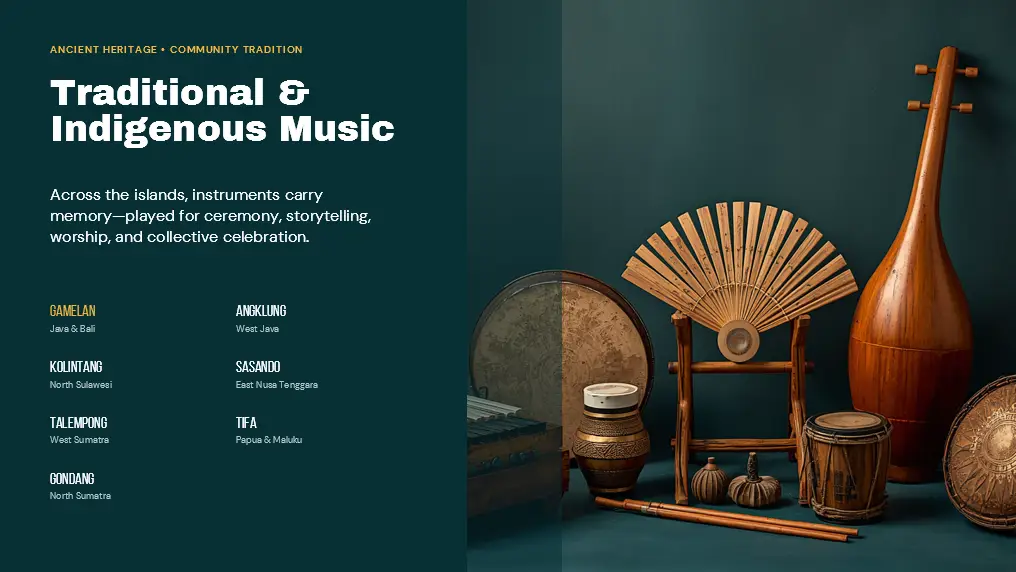
A gamelan ensemble isn’t a random collection of instruments. It’s a matched set, tuned specifically to work together — metallophones (bronze-keyed instruments played with mallets), hanging and horizontal gongs, xylophones, drums (kendang) that guide the tempo, and often a bowed string instrument (rebab) or bamboo flute (suling) weaving a melodic line above the percussion. In many performances, a singer (pesinden) adds voice to the texture.
What makes gamelan instantly recognizable is its tuning. Two systems dominate: slendro, a five-tone scale with roughly even spacing, and pelog, a seven-tone scale with uneven, more dramatic intervals. Neither maps cleanly onto Western do-re-mi — which is exactly why gamelan sounds like nothing else on Earth.
Play a Javanese gamelan piece and you’ll hear something contemplative — a central melody unfolding slowly, surrounded by interlocking parts (a technique called kotekan) that add shimmer and depth without ever rushing. Cross the strait to Bali, and the mood flips entirely: gamelan gong kebyar explodes with sudden tempo shifts, blazing unison hits, and interlocking runs so fast they sound like a single instrument played by twenty hands.
Cultural Context
Gamelan has never been background music. It accompanies wayang kulit shadow puppet performances late into the night, drives temple ceremonies and offerings in Bali, sets the pace for court dances that once entertained sultans, and marks life’s passages in villages across the archipelago — weddings, harvests, rites of passage.
Crucially, gamelan is communal by design. There’s no soloist stepping into a spotlight; the music only works when every player commits to their interlocking part. Learning gamelan, in many communities, is inseparable from learning how to listen — to the group before the self.
In 2021, UNESCO recognized Indonesian gamelan on its Representative List of the Intangible Cultural Heritage of Humanity, affirming what Indonesians have long known: this is a living tradition, still taught, still played, still evolving.
Photo / Video
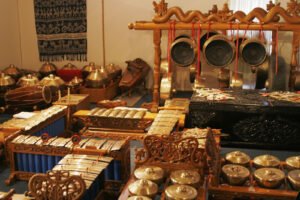
– Karya sendiri
Related Stories
- Wayang Kulit: Shadows, Puppets, and the Stories They Tell
- The Sound of Bali: Gamelan Gong Kebyar
- How a Gamelan Set Is Made: Bronze, Fire, and Tuning by Ear
Watch
The Shadows That Speak-A Wayang Kulit Story
Night falls softly over Java, and with it comes the ritual of light and shadow. A screen of white cloth is raised like a veil between worlds. Behind it, a single oil lamp trembles awake — small, golden, patient. It knows what is coming.The dalang sits cross-legged in the dark, surrounded by hundreds of puppets laid like sleeping spirits at his feet — kings and demons, lovers and tricksters, each cut from buffalo hide and gilded with careful hands. Tonight, he will breathe life into all of them. Tonight, he is not one voice, but many.The gamelan stirs. Bronze and brass hum awake, a heartbeat rising slow beneath the dark.Then — a puppet lifts.
A shadow is born.It falls across the screen not as a shape, but as a whisper made visible — trembling, elegant, ancient. The audience does not watch the puppets. They watch what the puppets become: fleeting ghosts of gods and heroes, flickering between worlds of flesh and myth.The dalang’s voice deepens into thunder for a demon king, then softens like river water for a devoted queen. His toes strike a wooden hammer against the gamelan’s edge, calling music like weather — a storm for battle, a hush for sorrow, a single note for a heart quietly breaking.Hours dissolve like incense smoke. Children drift to sleep against their mothers’ shoulders, carried into dreams by the same stories their grandparents once fell asleep to. Old men nod at truths hidden inside jokes — the eternal war between light and dark, staged nightly not on some distant battlefield, but within the shadow of every human soul.
For this is wayang kulit’s oldest secret: the puppets are not the story. The shadows are. We are shadows too — brief, flickering, cast by something larger than ourselves, dancing across the screen of time before the lamp dims and the night folds quietly around us. By dawn, the gongs fall silent. The lamp gutters low. The screen, once alive with gods and kingdoms, is still. But somewhere — in memory, in blood, in the hush between generations — the shadows never really leave.They only wait for the next flame.
A Traditional Style Reimagined: Keroncong
A good example of “traditional music, modern style” is keroncong.
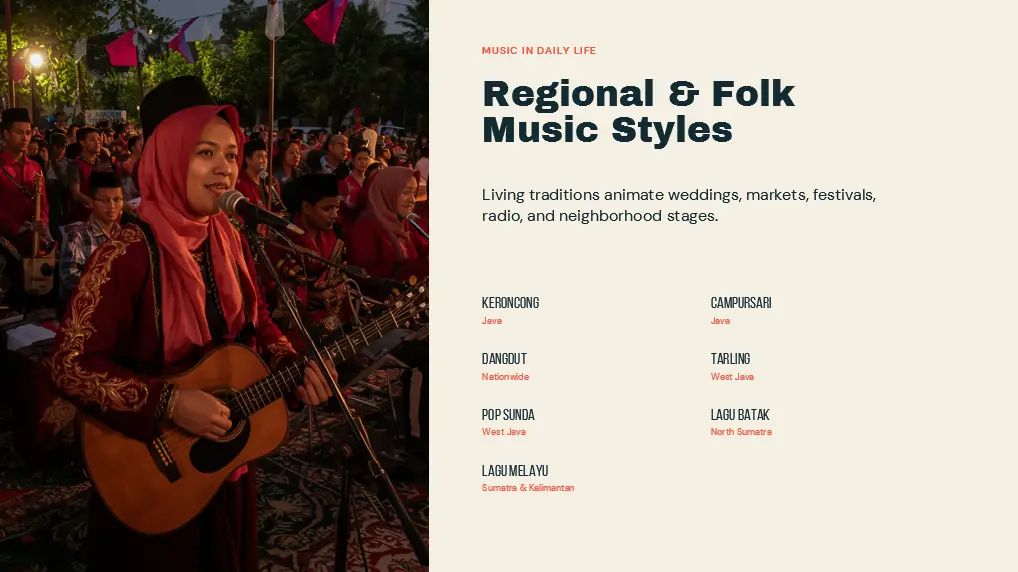
The traditional form: Keroncong emerged centuries ago from Portuguese trading influence, blending it with Javanese and Malay musical sensibilities. It’s built around a small string ensemble — ukulele-like cuk and cak, guitar, cello (played pizzicato, almost like a bass), flute, and violin — with a gentle, waltz-like sway and a distinctive “chrong-chrong” strumming pattern that gives the genre its name. Vocals are typically soft, melancholic, and poetic, often about longing, nostalgia, or nature.
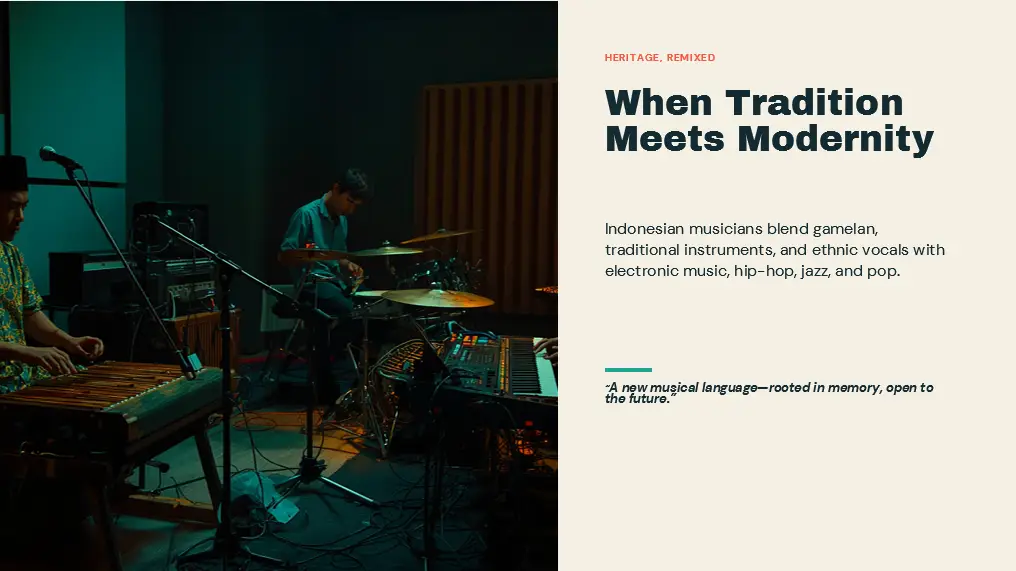
The modern reimagining: In recent decades, artists have taken keroncong and layered it with modern production — drum machines, synth pads, electric bass, even trap hi-hats — while keeping the core cuk/cak strumming pattern and that same wistful vocal delivery intact. This subgenre is often called keroncong modern or blended into pop keroncong. Some producers go further, sampling keroncong vocal phrasing into lo-fi or chillhop beats, or having orchestral arrangements replace the traditional small ensemble for a more cinematic feel.The result keeps keroncong’s emotional signature — that gentle nostalgia — while making it sound at home on a modern playlist next to pop and indie tracks. It’s a good illustration of how Indonesian musicians treat tradition not as something frozen, but as raw material to keep reshaping.
MODERN INDONESIA
From gamelan’s shimmering rhythms to dangdut’s lively beats, Indonesian music carries stories of community, ceremony, migration, and everyday life across the archipelago.
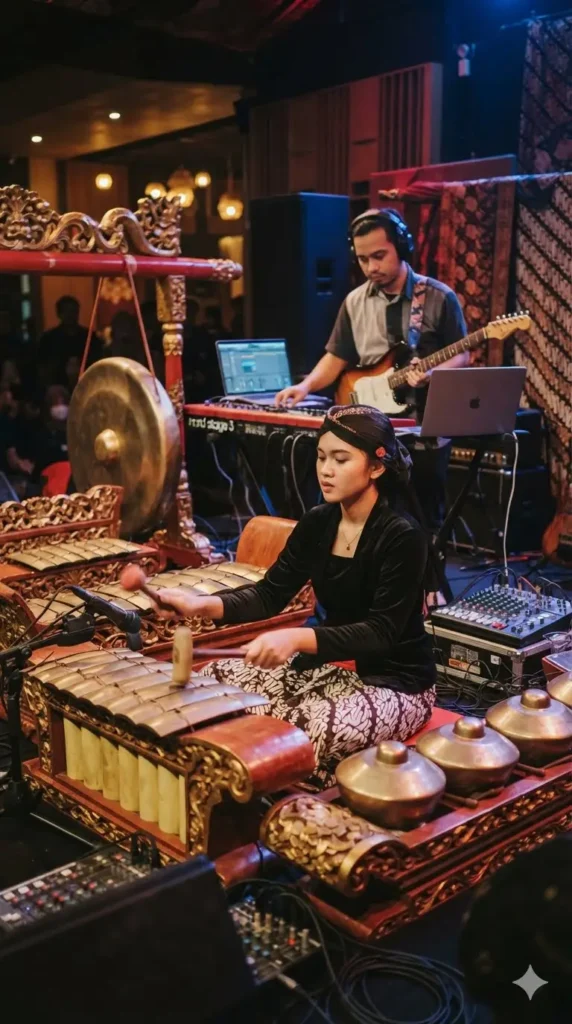
Basajan is an experimental instrumental quartet from Kabupaten Bandung, West Java, Indonesia, crafting a sound they describe as “Priangan Psychedelic Groove” — a name that nods to the Priangan (Parahyangan) highlands of West Java, the ancestral heart of Sundanese culture. [mood]
Their music draws on Sundanese traditional harmony fused with a mind-bending psychedelic groove sensibility, blending old and new: the tonal textures of Sundanese folk music layered into hypnotic, exploratory instrumental soundscapes. Mood + 2A few of their tracks include titles like Talaah, Uleman, Ageman, and Wilujeng — which appear on platforms like Apple Music alongside other releases such as “Nadoman.” They’re an active touring act, with upcoming tour dates listed for 2026. [apple music]
They represent a compelling angle: young Indonesian musicians reinterpreting Sundanese tradition through a global, experimental lens rather than presenting it as static heritage.
DANGDUT
REGIONAL SONG