Bridge Hub | Connecting Global Investors & Culture to Indonesia — NusaVibes
It often starts with a visit — travelers who come to Indonesia and fall in love with its culture, its people, and its places. Bridge Hub is where that curiosity turns into opportunity, guiding you from cultural discovery toward market intelligence, business insight, and investment pathways through our NusaVibes Advisory partners.
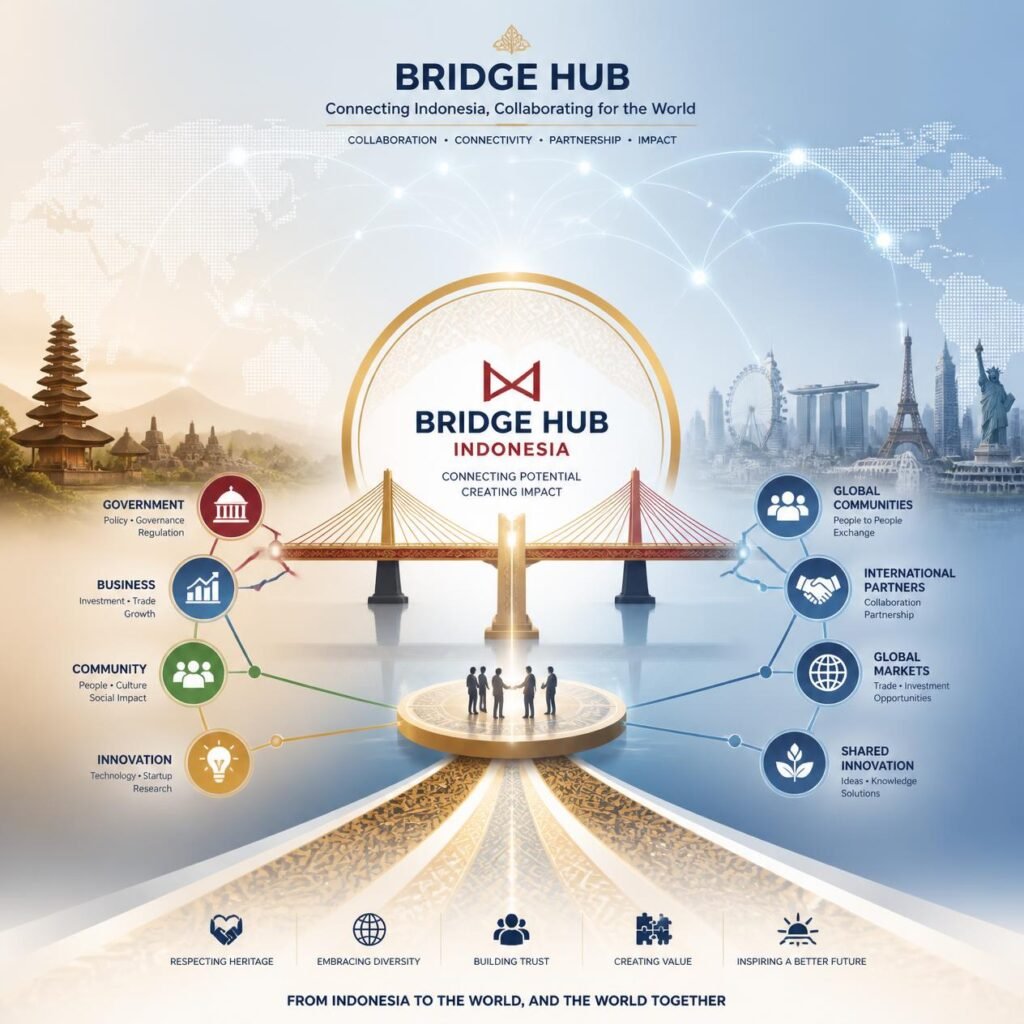
Bridge Hub is designed to facilitate meaningful connections and collaboration between individuals, businesses, institutions, local governments, and international communities.
Bridge Hub creates the actual connections between Indonesian stakeholders and international communities.
Its purpose is to bridge local potential with international opportunities by creating channels for communication, partnerships, investment, cultural exchange, knowledge sharing, and community development.
Bridge Hub brings together stakeholders from different sectors and backgrounds, helping them identify common interests, develop partnerships, and transform opportunities into practical initiatives.
Core Functions
1. Connect
Connecting local communities and institutions with international organizations, businesses, investors, professionals, and communities.2. Facilitate
Creating communication channels between stakeholders and helping facilitate introductions and potential partnerships.3. Promote
Showcasing local potential, projects, culture, investment opportunities, and community initiatives to international audiences.4. Collaborate
Supporting partnerships between government, private sector, institutions, communities, and international organizations.5. Develop
Encouraging initiatives that contribute to sustainable economic, cultural, social, and community development.
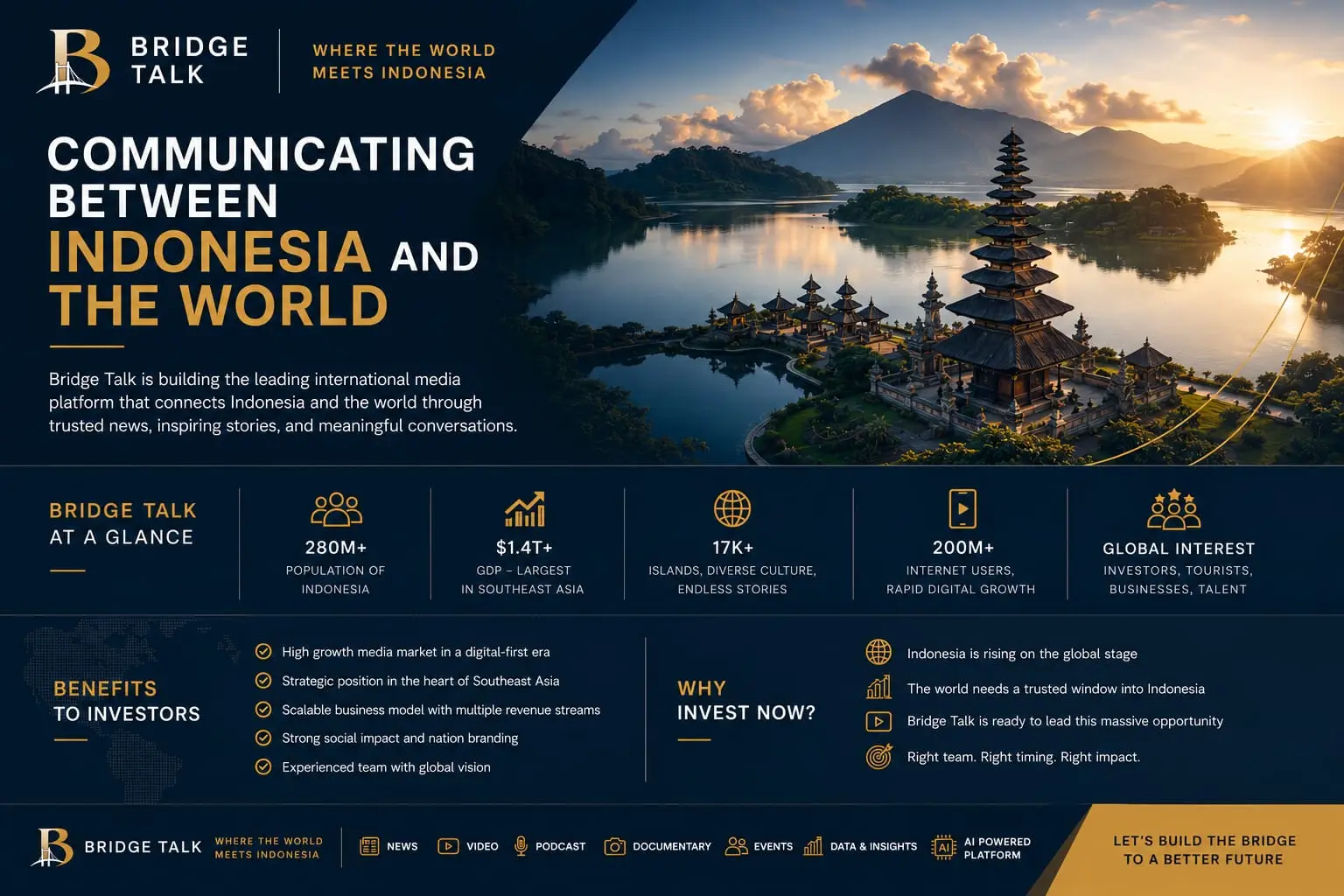
Bridge Talk – Where the World Meets Indonesia
This is an international digital media talkshow program dedicated to connecting Indonesia with the global community through trusted information, meaningful conversations, and compelling storytelling.
The program covers business, investment, technology, culture, tourism, lifestyle, innovation, and current affairs, presenting Indonesia from a global perspective while bringing international ideas, people, and opportunities closer to Indonesia.Bridge
Talk aims to become a trusted communication bridge between Indonesia and the world, creating value for audiences, businesses, investors, institutions, and communities through digital media, strategic partnerships, and global content distribution.
Our vision is simple: to connect people, ideas, opportunities, and cultures—making Indonesia more accessible and relevant to the world.
“Connecting Indonesian strategic opportunities with international communities, investors, businesses and institutions.”
Danantara Indonesia (officially Badan Pengelola Investasi Daya Anagata Nusantara / BPI Danantara)
is Indonesia’s state investment and asset-management institution, launched in February 2025. It is designed to consolidate and manage major Indonesian state-owned assets and channel capital into strategic investments.
What is Danantara? Think of Danantara as a national investment vehicle—somewhat comparable in concept to sovereign wealth funds such as: Temasek — Singapore Norges Bank Investment Management — Norway ADIA — Abu Dhabi PIF — Saudi Arabia
The major difference is that Danantara has a strong mandate to manage and optimize Indonesia’s existing state-owned corporate assets, while also pursuing new investments .What assets does Danantara manage?Danantara was established to oversee major strategic SOE assets, including large companies such as: Bank Mandiri, Bank Rakyat Indonesia (BRI), Bank Negara Indonesia (BNI), PLN, Pertamina, Telkom Indonesia and other strategic state-owned enterprises. The objective is not simply to own these companies, but to increase their value, improve governance and efficiency, and create long-term investment returns for Indonesia.
Why is Danantara important? The strategic idea is:State assets → better management → higher productivity → reinvestment → economic growth. Instead of the government managing numerous large SOEs separately, Danantara can take a more centralized investment-management approach.
Potential areas include:
Energy
→ renewable energy, electricity infrastructure, downstream industries
Digital & Technology
→ data centers, telecommunications, AI and digital infrastructure
Healthcare
→ hospitals, medical equipment, pharmaceuticals and healthcare infrastructure
Infrastructure
→ transportation, ports, industrial estates and logistics
Manufacturing
→ downstream processing and strategic industries
Food & Agriculture
→ food security and agricultural supply chains
International Investment
→ partnerships and investments with foreign companies and institutions.Why foreign investors should pay attention
For international companies, Danantara could become an important gateway to large-scale Indonesian projects.For example, a Korean, Japanese, European, American or Middle Eastern company could potentially participate through:Danantara + Indonesian SOE + Foreign Strategic Partner rather than entering Indonesia completely independently.
This is particularly interesting for companies bringing: technology, capital, manufacturing capability, healthcare, technology, renewable energy, digital infrastructure, AI advanced industrial equipment international distribution networks.
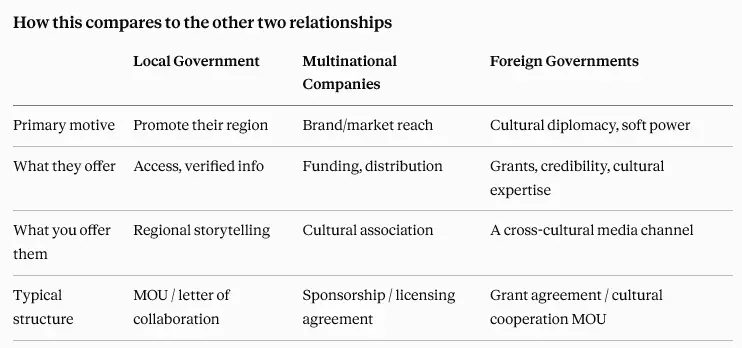
LOCAL GOVERNMENT
Given how NusaVibes is structured — with Destinations, Festivals & Events, and a dedicated “Partner With Us” CTA — there’s a natural, mutually-beneficial relationship it can build with local governments (dinas pariwisata / tourism offices, dinas kebudayaan / culture offices, and village or regional administrations). Here’s how that relationship typically works and what it could look like for your site:Why local government matters to NusaVibes
Legitimacy and access — Local governments often control or have privileged access to cultural sites, heritage data, festival schedules, and traditional communities (e.g., adat communities). Partnering gives NusaVibes credible, accurate, and exclusive content instead of relying only on secondary sources.
Content pipeline — Regional tourism/culture offices (Dinas Pariwisata dan Kebudayaan) regularly produce event calendars, heritage documentation, and promotional materials that map directly onto your Destinations, Festivals & Events, and Culture & Heritage categories. Distribution and reach — Governments want channels to promote local culture and tourism to a wider (including international) audience. NusaVibes can serve as that amplification channel, especially useful for regions with limited digital promotion budgets.
Validation for national branding — Since NusaVibes positions itself as a cultural/storytelling platform (not tourism marketing), it’s well-suited to be seen as a credible partner for “Wonderful Indonesia”-style national branding efforts, rather than a competitor to official tourism boards. What the relationship could look like in practice
Content partnership: Local government supplies verified information (festival dates, historical background, cultural protocols) and NusaVibes turns it into polished stories/media.
Co-promotion: NusaVibes features an upcoming regional festival; local government shares/boosts the story through its own channels.
Data/resource access: Government open-data portals or cultural agencies (e.g., Kemendikbud’s cultural heritage registries) as sourcing for the Culture & Heritage section.
Sponsored features or grants: Some regions fund media/content creators to document local culture — this could become a monetization or funding avenue tied to your “Partner With Us” page.
MULTINATIONAL COMPANIES
Multinational companies can play a different but complementary role to local government for NusaVibes — mostly around funding, distribution, and cross-border visibility rather than content access. Here’s how that relationship could work:Why foreign companies would be interested:
Cultural marketing appeal — Brands (tourism boards, airlines, hospitality groups, F&B, fashion, streaming platforms) often want to associate with “authentic culture” content to reach audiences interested in travel, heritage, or Southeast Asia and even the word. NusaVibes’ storytelling format is a natural fit for sponsorship rather than hard-sell advertising.
Market entry / soft diplomacy — Multinational companies entering the Indonesian market (or wanting to build brand affinity there) may see NusaVibes as a credible, non-corporate voice to associate with, similar to how a company might sponsor a documentary rather than run banner ads.
Content and distribution partnerships — Multinational travel platforms, streaming services, or media outlets may want to license, syndicate, or co-produce content (e.g., a “Music of Indonesia” video series) for their own international audiences.
Diaspora and international audience reach — Multi companies serving the Indonesian diaspora (fintech, remittance, airlines, telecom) may sponsor content to build goodwill and visibility with that audience segment.What the relationship could look like in practice
Sponsorship of a content series — e.g., an airline sponsors the “Destinations” category, or a streaming platform sponsors “Watch.”
Co-branded features — a multinational hospitality brand co-produces a story about a heritage site near one of their properties, clearly labeled as sponsored/partnered content.
Licensing and syndication — a multinational media outlet licenses NusaVibes stories/videos for international distribution, with revenue sharing or a flat licensing fee.
Affiliate or referral partnerships — multinational travel booking platforms (Booking.com-style) link out from Destinations pages, with NusaVibes earning referral commission.
Grants or CSR-style funding — some multinational companies fund cultural preservation or storytelling projects through CSR budgets, which could support specific NusaVibes initiatives (e.g., documenting an endangered tradition).
FOREIGN GOVERNMENT
Why foreign governments would engage with NusaVibes
Cultural diplomacy — Embassies and cultural attaché offices (e.g., through their embassy in Jakarta, or Indonesia’s embassies abroad) often fund or support cultural exchange, people-to-people programs, and media that builds mutual understanding. NusaVibes fits naturally as a channel for that.
Bilateral cultural programs — Many countries run formal cultural cooperation agreements with Indonesia (e.g., Japan Foundation, Goethe-Institut, British Council, Alliance Française, Korea Foundation, Australia’s DFAT cultural programs). These bodies actively fund storytelling, documentation, and cross-cultural media projects.
Public diplomacy / soft power — Foreign governments want positive visibility for their own country’s engagement with Indonesia — e.g., co-funding a story about Indonesian musicians collaborating with artists from their country, or documenting shared heritage/historical ties.
Development and cultural preservation funding — Some foreign governments (via aid agencies like USAID, JICA, AusAID-successor DFAT, or UNESCO-adjacent bilateral funds) support heritage preservation and traditional knowledge documentation — which overlaps directly with NusaVibes’ Culture & Heritage category.What the relationship could look like in practice
Cultural exchange features — a foreign embassy’s cultural section co-sponsors a story series on cross-cultural connections (e.g., “Dutch influence on Indonesian architecture,” “Japanese-Indonesian music collaborations”).
Grant funding — applying for or receiving grants from foreign cultural institutes or embassy small-grants programs earmarked for heritage documentation or creative media.
Official recognition/support — an embassy or cultural institute lends credibility by co-hosting a launch event, festival coverage, or exhibition tied to NusaVibes content.
Scholar/expert access — foreign government-funded cultural institutes often have researchers, curators, or archives that could be sourced for deeper cultural context pieces.
Language/audience expansion — some foreign cultural bodies fund translation of local content into their language for their own audiences (e.g., an Indonesian heritage story translated into Japanese for a Japan Foundation-funded initiative).